Introduction
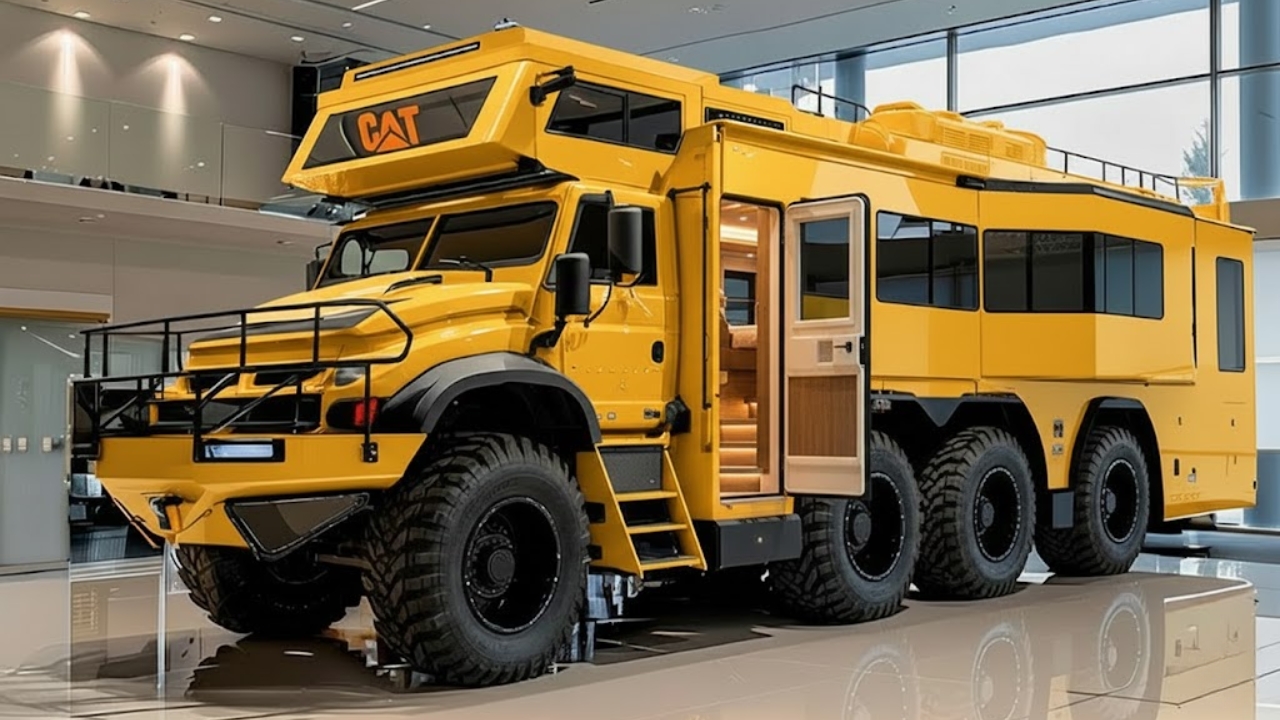
The 2026 Caterpillar 8×8 Overland RV Beast arrives as a statement of purpose: a mobile base camp built to survive, work, and live in the most remote corners of the planet. Riding on a purpose‑engineered 8×0 heavy‑duty chassis, the vehicle merges the durability of military‑grade equipment with the comforts expected from a premium overland rig. Whether the destination is the frozen tundra of Siberia, the sun‑baked dunes of the Sahara, or the jagged peaks of the Andes, this machine is intended to stay autonomous for weeks, if not months, without reliance on external infrastructure.
Exterior Architecture
The silhouette of the Beast is unmistakable. Its frame is constructed from a blend of high‑strength steel and carbon‑reinforced composite panels, delivering a body that can shrug off impacts from rocks, fallen branches, and even low‑order explosives. The chassis sits high above the ground, giving a ground‑clearance of roughly 18 inches and an approach angle that exceeds 45 degrees, allowing the vehicle to climb steep embankments without scraping the underbody.
Eight massive all‑terrain tires, each paired with a dual‑locking differential, provide continuous traction on sand, mud, ice, and loose gravel. The front bumper incorporates a reinforced steel bull bar equipped with a 12,000‑lb winch, while the rear of the vehicle features a tilt‑back ramp and a hydraulic lift for loading pallets, ATVs, or small utility boats.
Utility mounts are distributed across the roof and sides: two motor‑driven cargo racks, a modular solar‑panel array that can be expanded up to 12 kW, and side‑mounted gear boxes that house shovels, spare tires, and recovery equipment. Integrated LED light bars run the entire length of the roof, delivering up to 100,000 lumens of flood illumination, and a separate low‑profile beacon system flashes red and white signals for night‑time visibility.

Cabin Layout and Living Space
Inside, the Beast offers a layout that feels more like a compact research station than a traditional RV. The front cabin houses a dual‑zone climate control system capable of maintaining interior temperatures between –40 °C and +45 °C, thanks to active heating plates and a refrigerant‑based cooling loop.
The sleeping area comprises two converter beds that fold into modular lounge seats during daylight hours. Each bed is fitted with a memory‑foam mattress, an insulated bedding set, and individual temperature zones. A second, optional queen‑size module can be installed for larger crews, complete with an over‑head storage net for personal gear.

The core living module features a collapsible kitchenette equipped with a diesel‑powered induction cooktop, a convection oven, a combined fridge‑freezer unit sized at 250 L, and a pull‑out pantry that holds up to 150 kg of dry provisions. A stainless‑steel sink integrates a high‑flow pump and a built‑in water‑filtration system capable of producing 99.9 % pure drinking water from natural sources.
Hygiene is addressed with a wet‑bath suite that includes a pressurized shower equipped with a water‑recirculation system, a chemical‑free toilet that utilizes a vacuum‑seal waste compartment, and a separate hand‑washing sink. All surfaces are coated with anti‑microbial finishes, and the entire cabin is lined with acoustic dampening panels that reduce engine and wind noise to a whisper.

Navigation, Communication, and Electronics
The electronics hub sits behind the driver’s seat, featuring a triple‑screen command console. The central display provides real‑time terrain mapping sourced from a combination of satellite imagery, LIDAR scans, and inertial navigation sensors. Lateral displays show engine diagnostics, battery health, and a comprehensive suite of driver‑assist features.
Connectivity is assured through a dual‑band satellite modem capable of handling both broadband internet and low‑latency voice channels. In areas where cellular service is available, a seamless handoff to LTE/5G networks ensures constant Wi‑Fi coverage within the cabin. An integrated UHF/VHF radio system, coupled with an AIS transceiver, allows for emergency distress signaling and coordination with other expedition teams.

Power management is overseen by a smart battery management system (BMS) that monitors the 48 V lithium‑iron‑phosphate bank, predicts consumption patterns, and automatically switches between solar, alternator, and a secondary diesel generator rated at 12 kW. Energy‑saving modes can be activated manually or via AI‑driven algorithms that learn the crew’s daily usage habits.
Powertrain and Performance Characteristics
At the heart of the Beast lies a 16‑liter, turbocharged diesel engine delivering 850 hp and 3,200 Nm of torque. The engine is paired with a twelve‑speed automatic transmission featuring an auto‑lock feature for the differentials, enabling the driver to select a “crawl” mode that locks all eight wheels for rock‑crawling or a “high‑speed” mode that unlocks the rear axles for highway cruising at up to 105 km/h.
Fuel capacity totals 1,800 liters, stored in dual tanks protected by impact‑resistant bladders. The vehicle’s range exceeds 4,000 km on a single fill when operating under mixed terrain conditions. A regenerative braking system harvests kinetic energy during descents, feeding it back into the main battery pool.
Cooling is managed by a multi‑stage radiators and an oil‑to‑water heat exchanger, allowing operation at high altitudes where air is thin. The engine conforms to EPA Tier 4 emissions standards, employing selective catalytic reduction (SCR) and a diesel particulate filter (DPF) that can be regenerated autonomously.

Suspension, Ride Comfort, and Handling
The suspension architecture utilizes a combination of double‑wishbone arms, air‑sprung coil‑over shocks, and hydraulic dampers tuned for an 800 mm wheel travel. Each wheel can articulate independently up to 45 degrees, providing unmatched ability to keep all eight tires in contact with uneven ground.
Active roll‑stabilization sensors continuously adjust damper pressure to counteract body roll during cornering, even on loose gravel. The steering system incorporates power‑assist with variable‑ratio feedback, delivering a tighter turning radius of 7.5 m despite the vehicle’s 12‑meter length.

Braking is handled by high‑performance disc units on each wheel, paired with an ABS system that can be overridden for “off‑road” mode, allowing the driver to modulate brake pressure manually for fine control on steep descents.
Safety Systems and Driver Assistance
Safety is addressed through layered redundancy. A structural cage built from high‑tensile steel frames the cabin, providing a protective envelope that meets FIA Grade 2 standards. The vehicle is equipped with front‑impact and rear‑impact mitigation sensors that automatically pre‑tighten seat belts and deploy side curtains.

Multiple cameras—front, rear, and side—feed a 360‑degree view onto the central console, while radar and LIDAR arrays generate a real‑time occupancy map that alerts the driver to hidden obstacles. Night‑vision is achieved through infrared sensors that project a clear image onto a heads‑up display, and a thermal imaging camera monitors the vehicle’s perimeter for wildlife or intruders.
An integrated emergency beacon can transmit the vehicle’s GPS coordinates, health status, and a short distress message to rescue coordination centers via the Iridium network. The beacon is powered by an independent backup battery that can survive a full power loss for up to 72 hours.
Storage Solutions and Practical Features
Every cubic meter of the Beast is devoted to purposeful storage. Exterior side lockers, lockable and weather‑sealed, store power tools, spare parts, and recovery gear. A rear cargo bay accommodates a 2‑ton payload, featuring a hydraulic lift platform and an adjustable tie‑down system.
Inside, modular storage modules line the walls, each with slide‑out drawers and magnetic latches for quick access. A built‑in workshop area includes a pneumatic torque wrench, a weld‑bench, and a 3‑D printer capable of fabricating small replacement components on the road.
Heavy‑duty flooring made from abrasion‑resistant polymer protects against punctures and chemical spillage. A dedicated water‑treatment room houses a 2,000‑liter fresh‑water tank, a 2,000‑liter waste‑water tank, and a UV sterilization system for recycling grey water when needed.
Market Position and Expected Pricing
The 2026 Caterpillar 8×8 Overland RV Beast occupies a niche at the top end of the global expedition‑vehicle market. Comparable offerings from specialist manufacturers such as EarthRoamer, Global Expedition Vehicles, and Unimog tend to price between US$800,000 and US$2 million, depending on customizations.
Given the extensive built‑in technology, the reinforced chassis, and the comprehensive off‑grid support systems, the projected base price for the Beast is anticipated to fall in the US$1.5–1.8 million range. Optional packages—including Arctic‑ready insulation kits, desert‑sand filtration modules, and a hybrid‑electric powertrain—can add an additional US$250,000 to $400,000.
Final Assessment
Caterpillar’s 2026 Overland RV Beast sets a new benchmark for self‑sufficient exploration. Its blend of raw mechanical strength, refined living comforts, and a sophisticated electronic suite makes it a viable platform for scientific research teams, humanitarian relief units, and extreme adventure enthusiasts alike. While the price tag signals that it is not a vehicle for casual weekend campers, the value proposition lies in its ability to operate indefinitely without external support, turning any remote corner of the globe into a functional base of operations. For those whose ambitions exceed the limits of paved roads, the Beast offers both the freedom and the security to venture further than ever before.
Frequently Asked Questions
1. What is the expected fuel consumption in mixed‑terrain operation?
In combined on‑road and off‑road usage, the diesel engine averages about 20 L/100 km, which translates to roughly 12 mpg. Consumption rises to 30–35 L/100 km in extreme sand or deep‑snow conditions.
2. Can the solar array be expanded after purchase?
Yes. The roof mounting points are designed for modular expansion up to 12 kW, and additional panels can be installed without removing existing ones.
3. How long does it take to charge the onboard battery from solar alone?
With the full 12 kW solar configuration under optimal sunlight, the 48 V lithium‑ion bank can be replenished from 20 % to 80 % in approximately 8 hours.
4. Is a off‑road driver’s license required?
License requirements vary by jurisdiction. In most countries, a standard Class A commercial driver’s license is sufficient, but local authorities may demand a special endorsement for vehicles exceeding 3.5 tonnes.
5. What warranty options are available?
Caterpillar offers a standard 3‑year/100,000‑km powertrain warranty, with optional extensions up to 7 years for the chassis, electrical systems, and interior fittings.
Disclaimer
The information presented herein reflects the specifications and market expectations for the 2026 Caterpillar 8×8 Overland RV Beast as of the date of writing. All details are subject to change pending final production decisions, regulatory approvals, and customer customization choices. Prospective buyers should consult official Caterpillar representatives for the most current data and purchase terms.